
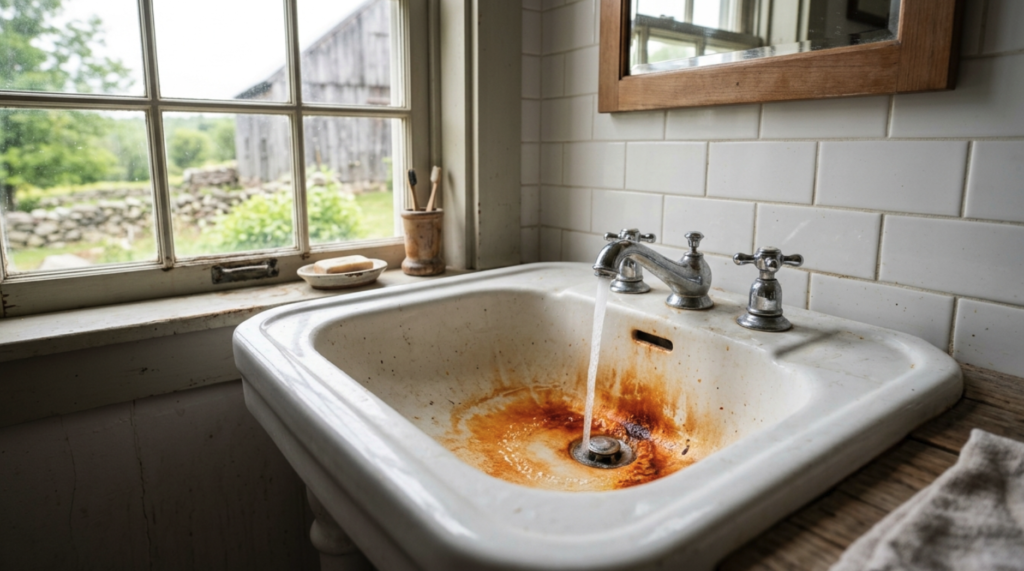
Orange or rust-colored stains in your sinks, toilets, and laundry mean iron in your well water. It’s the most common water complaint from well owners in Westport, Rehoboth, Tiverton, and Little Compton; but it’s fixable. The right fix depends on which form of iron you have, which is why testing comes before any equipment.
Why our area’s wells run orange
The bedrock and glacial soils across the Massachusetts South Coast and eastern Rhode Island naturally carry iron and manganese. Groundwater picks up the minerals on its way to your well. It’s not contamination from anything anyone did, and iron at these levels isn’t a health hazard. It’s a nuisance mineral, and the nuisance is real: stained fixtures, orange-tinged laundry, metallic-tasting coffee, and water heaters that fill with sediment years before their time.
If your neighbors on well water see the same stains, that’s the geology talking.
The two kinds of iron, and why it matters
Dissolved (clear-water) iron comes out of the tap clear, then stains later as air oxidizes it. Fill a white bucket: clear now, orange residue after sitting means dissolved iron.
Oxidized (red-water) iron arrives already orange or with visible particles. It often shows up worse after heavy pumping or a big rain.
Many wells around here have both, plus manganese, which stains black-brown instead of orange. Each form needs different treatment, and equipment matched to the wrong form is money down the drain, literally. A recent water test from your town or a lab tells us exactly what’s in the water, and we quote the equipment that matches.
What actually fixes it
A water softener handles low levels of dissolved iron along with hardness. If your test shows modest iron and hard water, one system may cover both.
An iron filter (air-injection oxidizing filters are the common choice here) handles moderate to heavy iron and manganese. It converts dissolved iron to particles and traps them, no chemicals, minimal maintenance.
Sediment pre-filtration protects everything downstream when particles are heavy.
The honest answer for your house lives in the test results. Iron level, manganese level, pH, and hardness together point at one right-sized setup, and we quote from those numbers.
What it does for the rest of your plumbing
Iron doesn’t just stain what you can see. It builds up in water heaters, clogs aerators and showerheads, and shortens the life of fixtures and appliances. Homeowners who treat an iron problem usually notice the water heater running quieter and the pressure evening out within weeks. Treating the water is cheaper than replacing what untreated water wears out.
Frequently Asked Questions
Is iron in well water dangerous to drink?
At the levels typical in our area, no. Iron is a secondary (aesthetic) contaminant. The stains, taste, and appliance wear are the problem, not your health. A full water test also screens for things that do matter, which is another reason to test.
How much does a water test cost?
Basic iron, manganese, hardness, and pH testing is inexpensive. A recent water test from your town or a lab tells us exactly what’s in the water, and we quote the equipment that matches. If you want a full lab panel (bacteria, nitrates, arsenic), we’ll point you to a certified lab.
Will bleach or rust removers fix the stains for good?
They clean the symptom. The stains return with the next tank of water. Treatment at the point where water enters the house is the only fix that lasts.
My water smells like rotten eggs too. Same problem?
Often related. Sulfur odor frequently travels with iron in local wells, and the same air-injection filtration that handles iron can be configured to handle sulfur. The test tells us.
How long does installation take?
Most iron filter or softener installations are done in a day, plumbed into the main line where water enters the house.
If the stains are showing up in Westport, Rehoboth, or Tiverton, you’re not alone, and the fix is a matter of matching equipment to what’s actually in the water. Get a water test, then call (508) 501-7424 with the numbers. We’ll tell you what they mean and put a quote in writing. Or request a callback.