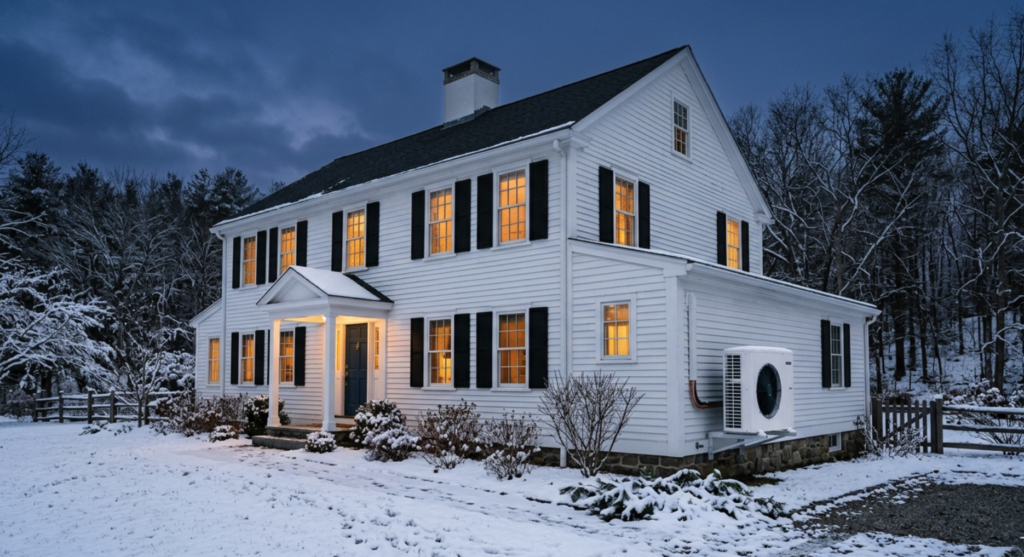
Roughly a third of the heat pump installations in older southeastern Massachusetts homes need electrical panel work first. A whole-home heat pump adds a large 240-volt load, and a 100-amp panel from the 1970s often has no room for it. Here’s how to know if you need an upgrade:
The quick way to check your panel
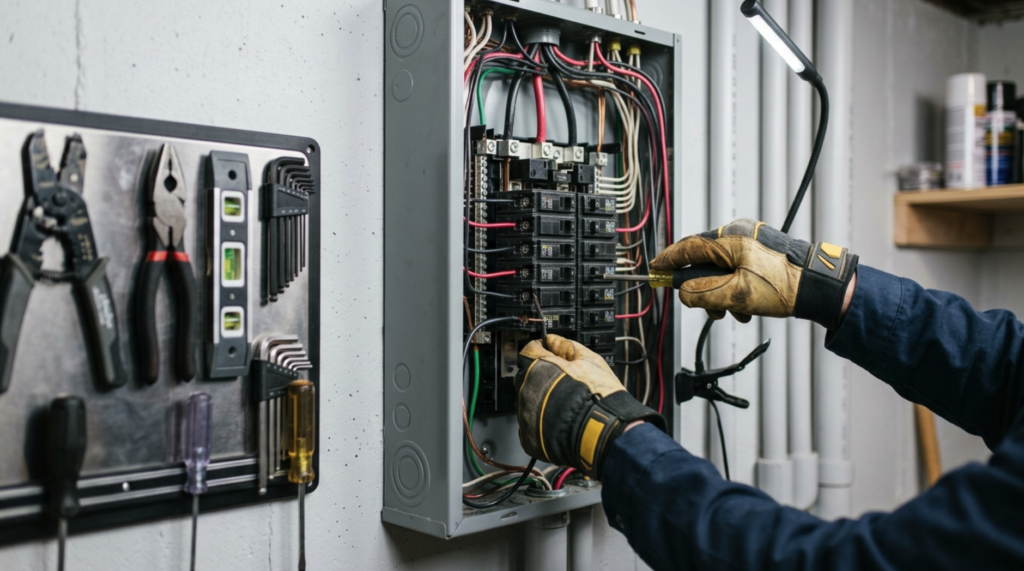
Open your electrical panel door and look for the main breaker number at the top: 100, 150, or 200. Then look at the breaker slots. If you have 100-amp service and the panel is already full of breakers, a heat pump probably doesn’t fit without an upgrade. If you see fuses instead of breakers, the answer is almost certainly yes, and honestly, it was yes before the heat pump entered the picture.
Homes in Fall River, New Bedford, and Taunton built before 1980 are the usual suspects. So are the classic capes and colonials in Somerset and Swansea that have had window ACs doing the summer work for fifty years.
Why heat pumps stress old panels
A whole-home heat pump typically needs one or two dedicated 240-volt circuits, similar to adding an electric range and a dryer at the same time. The equipment itself is efficient, that’s the whole point, but the panel has to physically carry and protect the circuit. If the panel can carry it, the heat pump wires right in. If not, the panel comes first.
This isn’t a heat pump problem. It’s a 1975-panel-meets-2026-house problem. EV chargers hit the same wall.
The two-contractor trap
Here’s where most projects go sideways. The HVAC company quotes the heat pump, discovers the panel issue, and tells you to “have your electrician handle that first.” Now you’re coordinating two companies, two schedules, two permits, and two rounds of “we’re waiting on the other guy.” Projects stall for weeks this way.
Triangle runs licensed HVAC and licensed electrical under one roof. The panel evaluation happens during the heat pump quote, the panel work and the installation go on one schedule, and one company owns the whole outcome. When something needs adjusting, there’s nobody to wait on.
What the electrical side costs, and how Mass Save helps
Panel upgrade pricing depends on service size, meter location, and whether the utility needs to be involved, your quote will show the exact number for your house. The useful part: the 0% Mass Save HEAT Loan (up to $25,000, 7-year terms) can finance electrical work done as part of a qualifying heat pump project. The panel that was blocking the project gets folded into the same zero-interest financing as the heat pump itself.
Frequently Asked Questions
How do I know if my panel can handle a heat pump?
As a rule of thumb, 200-amp service almost always has room, 100-amp service with a full panel usually doesn’t. We check this during the heat pump quote.
Does a panel upgrade require the power company?
Sometimes. If the service wire from the street also needs upsizing, the utility coordinates the disconnect and reconnect. We handle that scheduling as part of the job.
Can the panel upgrade and heat pump install happen the same week?
Usually, yes. Because both trades are in-house, we sequence the electrical work directly ahead of the installation instead of leaving a gap between two companies.
Will Mass Save rebates cover the electrical work?
The heat pump rebates apply to the heat pump. But the 0% HEAT Loan can finance the full qualifying project, electrical work included, which is where most homeowners fold in the panel cost.
My lights flicker when the furnace kicks on. Related?
Possibly. Flickering under load can signal a tired panel or loose connections, both worth an electrician’s eyes regardless of any heat pump plans.
One call covers both trades: (508) 501-7424. Triangle Mechanical, heating, cooling, plumbing, and electrical for southeastern Massachusetts and Rhode Island since 1970.